12 June 2026 MOVIE MARTIAL ARTS
CAMERA ANGLES IN FIGHT SCENES
CAMERA ANGELS IN FIGHT SCENES
Camera Angles in Fight Scenes: How Filmmakers Create Impact, Realism and Emotion
Fight scenes are not defined by choreography alone. The way the action is filmed can dramatically influence how powerful, realistic, or exciting a fight appears on screen.
In martial arts cinema and modern action films, camera angles are one of the most important storytelling tools. They control what the audience sees, how movement is perceived, and how the emotional intensity of the scene is delivered.
From the dynamic Hong Kong cinema of Jackie Chan and Jet Li to the stylized action of The Matrix, filmmakers carefully select camera angles to enhance every punch, kick, and throw.
Understanding these techniques reveals why some fight scenes feel immersive and realistic while others appear chaotic or difficult to follow.
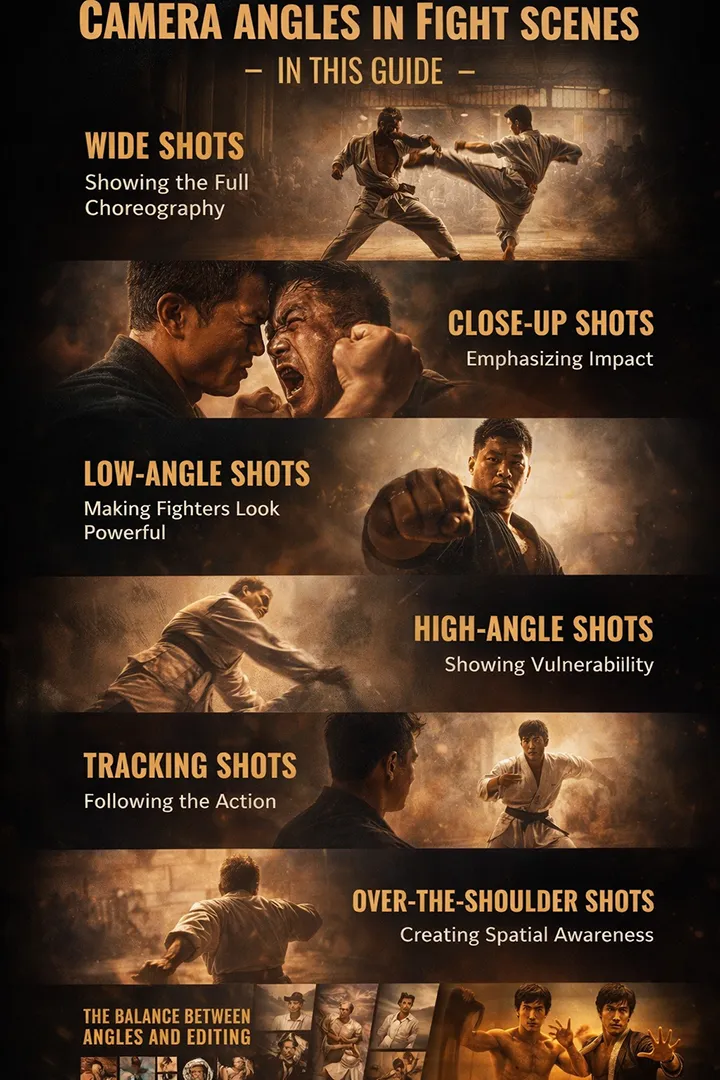

Wide Shots: Showing the Full Choreography
One of the most respected techniques in martial arts filmmaking is the use of wide shots. These shots capture the performers’ entire bodies and allow the audience to clearly see the choreography.
Classic Hong Kong martial arts films frequently use wide shots to showcase the physical ability of the actors and stunt performers.
For example, many action sequences in Crouching Tiger, Hidden Dragon rely on wide framing so audiences can appreciate the elegance of the sword choreography designed by legendary fight choreographer Yuen Woo-ping.
Wide shots are particularly effective because they:
• Reveal the full movement of techniques
• Demonstrate the performer’s real skill
• Reduce the need for excessive editing
When audiences can see the entire action clearly, the fight feels more authentic.
Close-Up Shots: Emphasizing Impact
While wide shots show movement, close-up shots emphasize emotion and impact.
Directors often cut to close-ups during key moments such as:
• A punch landing
• A character reacting to pain
• A weapon strike
These shots help the audience feel the intensity of the moment.
Close-ups are frequently used in dramatic martial arts scenes where emotional stakes are high. By capturing facial expressions and reactions, filmmakers remind viewers that the fight is not just physical - it is personal.
Low-Angle Shots: Making Fighters Look Powerful
Low-angle shots are filmed from below the subject, looking upward. This technique makes characters appear larger, stronger, and more intimidating.
In fight scenes, low angles can make a martial artist appear almost superhuman.
Films such as The Matrix use low-angle shots to enhance the mythic presence of characters like Neo, played by Keanu Reeves.
This visual technique subtly communicates dominance and strength to the audience.
High-Angle Shots: Showing Vulnerability
High-angle shots are the opposite of low angles. The camera looks down on the subject, making them appear smaller or weaker.
In fight scenes, these shots can highlight moments when a character is overwhelmed or vulnerable.
They are often used when a fighter is knocked to the ground or surrounded by multiple opponents.
By shifting perspective, filmmakers can visually reinforce the story’s emotional stakes.
Tracking Shots: Following the Action
Tracking shots involve the camera moving alongside the performers during the fight.
This technique creates a sense of immersion and allows the audience to experience the fight as it unfolds.
One of the most famous examples occurs in Oldboy, where the corridor fight scene follows Choi Min-sik as he battles multiple attackers with a hammer.
The camera moves horizontally along the hallway, creating the feeling of a side-scrolling action sequence. This approach allows viewers to see the choreography in near real-time while maintaining cinematic tension.
Over-the-Shoulder Shots: Creating Spatial Awareness
Over-the-shoulder shots place the camera behind one character while focusing on their opponent.
This perspective helps audiences understand the relative position of fighters during combat.
It is commonly used during dialogue moments within a fight or when two characters square off before exchanging attacks.
The technique keeps viewers oriented within the scene while maintaining dramatic focus.
The Balance Between Angles and Editing
Great fight scenes use a combination of camera angles rather than relying on a single approach.
Editors and directors carefully assemble shots to create rhythm and momentum.
However, excessive cutting can reduce clarity. When shots change too quickly, audiences may struggle to understand what is happening.
This is why many martial arts films favor longer takes and wider angles that allow the choreography to breathe.
Filmmakers must constantly balance clarity, intensity, and visual style.
Lessons from Martial Arts Cinema
Many of the best fight scenes in film history come from directors who understand both martial arts and cinematic storytelling.
Stars such as Jackie Chan built their reputation on performing complex choreography in long, clearly framed shots that showcase genuine skill.
Similarly, the action design of The Matrix blended martial arts choreography with innovative camera techniques, creating a style that influenced action cinema for decades.
These films demonstrate that powerful fight scenes are not simply about violence—they are about visual storytelling.
FAQ
1. Why are camera angles so important in fight scenes?
Camera angles are crucial because they help shape the viewer's perception of the fight. A well-placed camera angle can enhance the intensity, highlight the skill of the fighters, and provide clarity in complex sequences. The right angle can make the fight feel more dynamic, visceral, and immersive, keeping the audience engaged throughout the action.
2. What camera angles are most commonly used in fight scenes?
Some of the most common camera angles used in fight scenes include:
Wide Shots: Often used at the start to establish the location and the fighters’ positions.
Close-Ups: Used to show intense emotions, facial expressions, or the impact of hits.
Over-the-Shoulder Shots: These are great for showing the perspective of a character during a fight, allowing the audience to feel like they are in the action.
Low-Angle Shots: Often used to make the fighters look more imposing and powerful, emphasizing their physicality.
High-Angle Shots: Used to show vulnerability or highlight a fighter’s struggle.
3. How do directors use camera angles to create suspense in a fight scene?
Directors use camera angles to control pacing and build suspense in a fight scene. By switching between close-ups and wide shots, they can emphasize critical moments, like a near-miss or a powerful blow. Low-angle shots can make the fight seem more intense, while overhead shots can give the audience a clear view of the action, adding tension as they wait to see the outcome.
4. Can camera angles make a fight scene look more realistic?
Yes, the correct camera angles can enhance realism by providing a clearer view of the fighters' movements and making their actions seem more fluid and natural. For example, a wide shot can give the audience a sense of the space and positioning, while close-ups can highlight the intensity of the fight and the physical effort involved. When combined with proper editing and sound design, camera angles help bring the fight to life.
5. What role does editing play alongside camera angles in a fight scene?
While camera angles provide the visual foundation, editing is what brings the fight scene together. Quick cuts, match cuts, and carefully timed transitions between angles can create rhythm, build suspense, and highlight key moments of action. For example, a cut to a close-up after a hard punch can emphasize the impact, making it feel more dramatic. The speed of editing, in conjunction with the camera angles, can determine how fast-paced or intense a scene feels.
6. How does a director choose the right camera angle for a fight scene?
Directors select camera angles based on the story, the emotion they want to evoke, and the choreography of the fight. For instance, in a dramatic showdown, close-ups may emphasize the characters' emotions, while in a large, chaotic battle, wide shots may be used to show the scale of the conflict. Ultimately, the director’s choice should align with the tone of the scene and the overall visual language of the film.
Final Thoughts
Camera angles play a crucial role in shaping how audiences experience cinematic combat. The placement of the camera determines what the viewer sees, how the action feels, and how emotionally engaging the scene becomes.
By combining wide shots, close-ups, tracking shots, and dramatic perspectives, filmmakers transform choreographed movement into unforgettable moments on screen.
For aspiring stunt performers, martial artists, and filmmakers, studying camera angles in fight scenes offers valuable insight into how action cinema is crafted.
Behind every great fight scene lies not only skillful choreography, but also a camera carefully positioned to capture the perfect moment.
Are You Ready to Take Your Career to the Next Level?
Join Movie Martial Arts
Get access to exclusive training, tutorials, and resources that will transform your career.
CONTINUE LEARNING
If you want to break down iconic martial arts fight scenes, check out these related INSIGHTS articles:
Breakdown of Iconic Film Fight Scene – See how professional choreography creates some of the most memorable fight scenes.
How Movie Fight Scenes Are Created: A Complete Guide to Cinematic Action – Explore the entire process of creating cinematic fight sequences from choreography to camera angles.
Analyzing Fight Scene Pacing – Learn how pacing affects the energy and emotional impact of a fight scene.
Camera Angles in Fight Scenes – Understand how different camera angles enhance the dynamics of martial arts choreography.
The Role of Reaction Shots in Action Sequences – Discover how reaction shots build emotional depth and suspense in fight scenes
How to Become a Stunt Performer in Film and Television – Learn the necessary steps to break into stunt performing in the film and TV industry.